How many screens are in the room with you? Your phone, your laptop, your iPad, your desktop, your TV. Maybe a smartwatch. Maybe a smart fridge. For many of us, the mediated image is not something we step away from to experience theater. It arrives with us, woven into our perception. For decades, artists have been grappling with this fact.
Live video entered the theatrical stage as early as the 1980s, most notably through the radical mise-en-scène of Frank Castorf at the Volksbühne in Berlin. Castorf’s work, particularly beginning in the early 1990s and extending through the 2000s with collaborators like Bert Neumann and video artist Andreas Deinert, used handheld cameras and jarring screen presence to fracture time, foreground mediation, and expose the constructed nature of representation. Meanwhile, in New York, The Wooster Group was already embedding live-feed cameras and CRT monitors into their dense, fragmented stagings, mapping performance onto the logics of editing, feedback, and deconstruction. Big Art Group emerged in the early 2000s with what it called “Real Time Film,” a technique that used green screen, projection, and live compositing to split performance into doubled temporalities, what happens live, and what happens onscreen, and make visible the ideological and political construction of media.
Since then, live video has become ubiquitous. Ivo van Hove’s large-scale productions at Internationaal Theater Amsterdam, West End, and Broadway use cinematic close-up and architectural projection to create psychological intimacy at scale. Small downtown spaces and indie productions utilize inexpensive handheld cameras, phone feeds, and hacked surveillance to stage liveness as a mediated, fragile negotiation. At every level of production, from Off-Off Broadway basements to Broadway houses, the screen is no longer an intrusion but part of the vernacular of theater itself.
Still, some audience members and critics continue to ask, “Is this theater?” or, “Why is the video necessary?” as if the presence of a camera somehow disqualifies the work from theatrical legitimacy. But in 2025, when most of our lives are lived on multiple screens, the more urgent question might be: how does the screen shape our seeing, our time, our sociality, and our bodies? And what does it mean to watch performers live through the frame?
We are no longer only here, in this room, in this moment. Our bodies and selves are captured, stretched, and dispersed across digital networks, spaces of image, video, avatar, and profile. We live in time and space, and we are also projected and networked into other spaces as reproductions, copies, avatars, and extensions. Some of these are close to the real, to the lived and felt you. Others are partial, performed, or false. The tension between presence and projection, between original and copy, between materiality and simulation, is not abstract. It is daily. It is intimate. And it is at the core of what theater now confronts, through the camera, through the screen, through the staged and the streamed.
“The tension between presence and projection, between original and copy, between materiality and simulation, is not abstract. It is daily. It is intimate.”
Łukasz Twarkowski is an internationally recognized creator of rich multimedia theatrical work, operating at the intersection of theatre, visual arts, music, and digital technologies. He consistently interrogates the boundaries and capacities of theatre as a medium, deploying live video, real-time compositing, and deconstructed narrative to confront audiences’ ingrained viewing habits and challenge what is real or constructed.
Twarkowski has built a significant international profile: past works include Kliniken / Love is colder than… Akropolis, Lokis, Respublika, and ROHTKO. His productions have toured major venues and festivals, including Odéon Théâtre, Ruhrtriennale, New York’s Skirball Center, Piccolo Teatro Milano, Münchner Kammerspiele, Wiener Festwochen, and London’s Southbank Centre.
In Respublika (2020), which appeared at the Holland Festival in 2023, Twarkowski staged a six-hour immersive installation blending techno, film, performance, and communal ritual. He pushed the audience to choose their own trajectory, between screens, the dance floor, and the theatrical set, asserting that “theatre on its own is no longer enough”; instead, he seeks hybrid forms born of video and liveness.
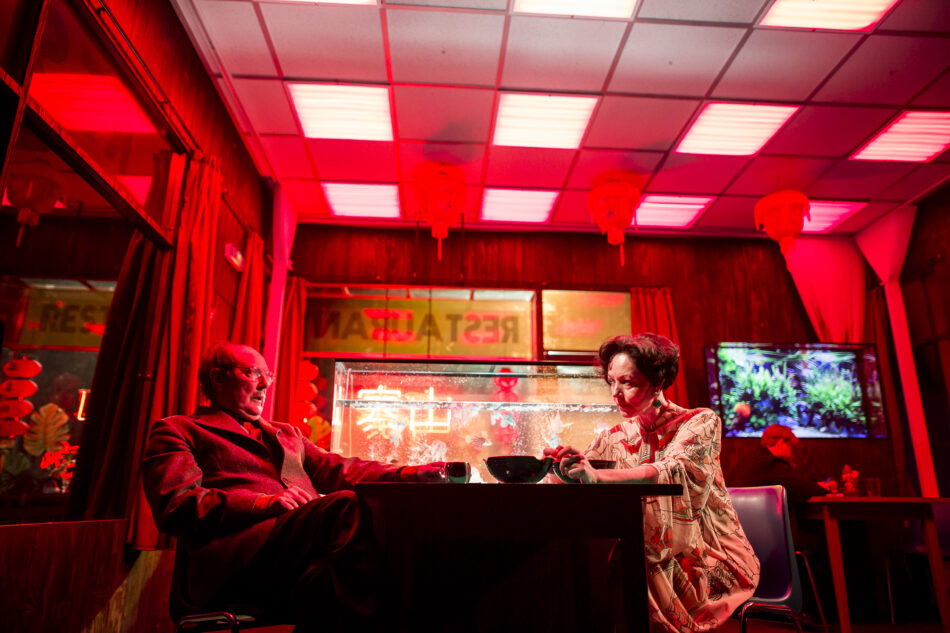
ROTHKO, which ran at the Holland Festival this past month, opens with an illusion: two seemingly pre-recorded shots, one of a Chinese restaurant kitchen, the other of a Wolt delivery person, framed in high cinematic detail and projected on separate large rolling screens on a bare stage. But slowly, the illusion cracks: the footage is live. From the very first moment, the production destabilizes the boundary between the authentic and the copy. The rupture that follows is explosive, a loud, kaleidoscopic scenic shift that feels more like cinematic vertigo than theatrical transition. The kitchen set glides out. A Chinese restaurant spins onto the stage. A massive widescreen projection, like an exaggerated, suspended Cinemascope frame, flies in from above. Handheld cameras begin to move. The restaurant structure rotates in full as actors and camera operators step in and out, revealing a corridor of neon-lit fish tanks, green linoleum tabletops, bustling diners, and waitstaff. Everything in the space is in motion. Moving scenery glides into place. Actors hit their marks with exactitude. Lighting cues and handheld cameras track and sculpt every shift in real-time.
Within this suprising architecture, the story begins to take shape. A man and a woman meet inside the restaurant, a dealer and an art handler, possibly former lovers. Their interaction is terse, ambivalent, and charged with personal and professional subtext. Simultaneously, another encounter unfolds between two men: a gallerist and a reporter. The staging is thick with simultaneity, like a long cinematic take, reminiscent of Robert Altman’s layered realism or Wong Kar-wai’s neon lite intimacy. The set, with its walls, windows, and reflective surfaces, obscures and reveals the live action in a nod to the form’s originators, such as Castorf and Neumann. There are fish tanks with believable but artificial fish, and others that appear live, only to reveal themselves as screens. These visual contradictions echo the deeper thematic inquiry: what is real, what is fake, what is copied?
Another musical rupture arrives as a thundering pulse, like a jump scare, the audience actually flinched, disorienting and deliberate. The Chinese restaurant set splits in two and begins to rotate. The kitchen transforms into an outdoor street stall, where the reporter interviews the dealer about her forged Rothko paintings, which were sold for millions. Then everything rotates again. The kitchen becomes a portal between two mirrored Chinese food restaurants, a doubling: two timelines, two Americas, two Rothkos.
One-half stages Mark Rothko in 1960, in conflict with his wife over his decision to reject a lucrative commission for the Four Seasons Restaurant, an iconic story of artistic refusal that also formed the basis of Romeo Castellucci’s 2012 The Four Seasons Restaurant. The other half is set in 2025: two actors discuss auditioning for a film about Rothko, each trying to claim the role. As timelines begin to blur, the image in the elongated projection screen above splits to match the dual narrative structure. This is then complicated by a lengthy, full-ensemble sequence, a virtuosic display of slow-motion, looped movement, time travel, and synchronized camera work. Actors begin to cross decades through the kitchen portal, between the two mirrored restaurants. It evokes the overstimulated excess of a music video or stadium performance, but remains grounded in an philosophical inquiry: What is an original? Can a copy still move you?
“From the very first moment, the production destabilizes the boundary between the authentic and the copy.”
What makes ROTHKO notable is the seamless integration of performance, scenography, and camera. The actors deliver emotionally precise, grounded work even as the stage is in flux, rotating, splitting, mirroring, and recombining. Their labor is constant and invisible: traversing moving scenery on cue, hitting tightly choreographed marks and lighting states, and adjusting to shifting camera positions. The live-feed cinematography is dramaturgical. It builds meaning through framing, doubling, and movement. Camera operators and stage crew are fully visible, pointed to, framed, and folded into the logic of the piece.
By the second part, the restaurant has become something like an affinity spiral. It is mirrored front to front, forming a see-through structure where video, set, and actor loop and slide across registers of real and fake, now and then. The kitchen exists both physically and as an image. The fish tank now spans a massive projection wall, pulsing with scale and saturation. Through this unstable, shifting architecture, the production poses questions that echo and multiply: What gives art its value? Its originality? The emotion it elicits? Or its rarity? If you love a painting and later discover it is fake, is your love less real? Are we attached to aesthetic experience or to ownership and scarcity? And in a world of NFTs, blockchain-certified provenance, and infinitely reproducible digital objects, what does originality even mean?
These questions are not presented as abstract theory, but embedded in the visceral reality of the staging. The set unlocks, opens, spins, and turns like a sci-fi puzzle box, revealing new locations and decades. Screens shimmer with layered images. Costumes glimmer from vintage to contemporary. Choreography is employed as a structural principle, where entire scenes unfold as interlocking tableaux of rhythm, timing, and gesture. It’s a hybrid language that draws lineage from live theatrical video visionaries of the past 40 years. Yet Twarkowski renders this vocabulary his own, spatial, cinematic, philosophical, and relentless.
“The live-feed cinematography is dramaturgical. It builds meaning through framing, doubling, glitch, and movement.”
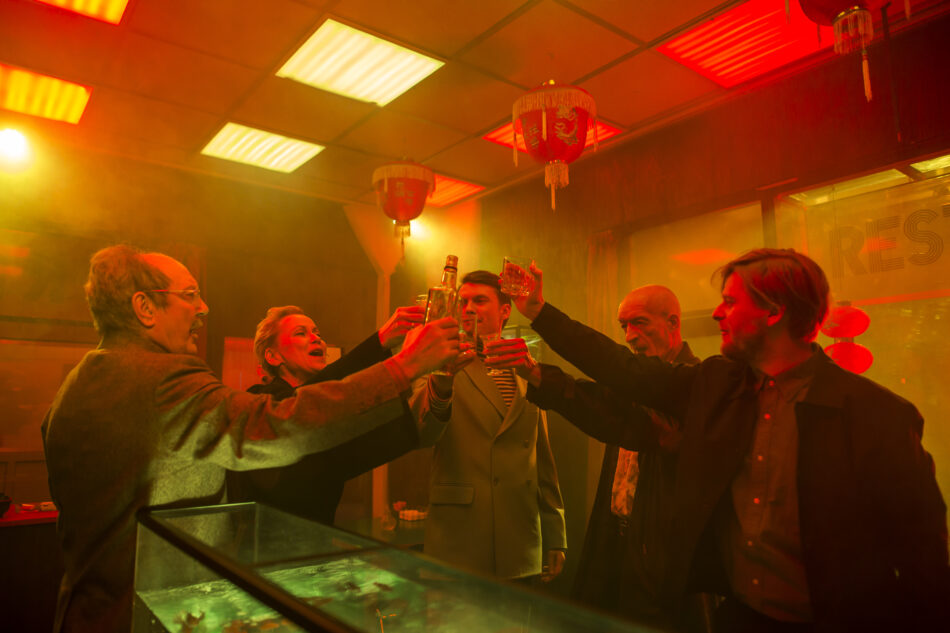
ROTHKO continues Łukasz Twarkowski’s deep engagement with mediated form, architectural scenography, and fractured temporality. Like his earlier work Respublika, it dissolves the boundaries between theatre, film, and installation. However, where Respublika immersed audiences in a durational, rave-like environment with distributed attention and a horizontal narrative, ROTHKO returns to a more vertical dramaturgy, structured, layered, and recursive. The camera is not a supplement to performance, but an actor within it. The screen is not a surface for illustration, but a machine of meaning. This marks a maturation of Twarkowski’s hybrid vocabulary: the interplay of liveness and image is tighter, more choreographed, and more embedded in the logic of the piece.
The production also signals Twarkowski’s position within a longer lineage of artists who have used live video to interrogate perception and theatrical time. There are clear echoes of Frank Castorf’s work at the Volksbühne, especially in the way screens fracture realism and gesture toward the ideological frame. The reflective materials and spinning architectural modules evoke Bert Neumann’s scenographic provocations. The use of simultaneous, durational camera feeds and layered cinematic rhythm recalls The Wooster Group and Big Art Group, companies who pioneered live compositing and feedback as dramaturgical tools. And like Ivo van Hove, Twarkowski stages subjectivity through framing, proximity, and rupture, using the camera to isolate and amplify emotional stakes.
Yet ROTHKO pushes these strategies further. It does not simply represent media, it performs mediation. It stages forgery not as a plot point but as an ontological condition. The set does not signify a restaurant, it performs the labor of duplication. The screens do not show the actors, they reveal the conditions of performance: the gaps, the seams, the excesses. In doing so, the piece asks urgent questions not only about art, value, and originality but about what it means to be seen in a world of copies. What kind of presence is possible when every gesture is split between its execution and its projection? What kind of theatre is possible when the camera is no longer observing but structuring the event?
“We recognize ourselves in these copies not because they are authentic, but because they reflect the conditions under which authenticity is now produced.”
What lingers after ROTHKO is not just its scale, precision, or virtuosity, but its willingness to embrace contradiction. It is both emotionally intimate and architecturally vast, conceptually rigorous and wildly excessive. It stages collapse without ever losing control. In its spinning worlds, mirrored timelines, and recursive frames, it enacts the very questions it asks: What is original? What is fake? What is the value of feeling when that feeling is mediated, duplicated, or multiplied?
The production does not offer resolution. Instead, it leaves the audience inside the loop, a copy of a copy of a copy, inviting reflection on how perception, desire, and meaning are shaped by duplication. It is not only about the art market, but about how we live inside systems of representation: theatrical, digital, economic, and political. We recognize ourselves in these copies not because they are authentic, but because they reflect the conditions under which authenticity is now produced.
Twarkowski has made a work that feels unmistakably of this time: fractured, dazzling, exhausted, precise. ROTHKO does not ask us to choose between the real and the fake. It shows us how deeply entangled they have become, and how performance, when staged with this level of craft and formal clarity, can still cut through the noise and show us something sharp, strange, and true.
Credits
direction Łukasz Twarkowski text Anka Herbut dramaturgy Anka Herbut stage design Fabien Lédé costume design Svenja Gassen choreography Paweł Sakowicz music Lubomir Grzelak video design Jakub Lech lighting design Eugenijus Sabaliauskas cast Juris Bartkevičs, Kaspars Dumburs, Ilze Ķuzule-Skrastiņa, Yan Huang, Andrzej Jakubczyk, Rēzija Kalniņa, Katarzyna Osipuk, Artūrs Skrastiņš, Mārtiņš Upenieks, Toms Veličko, Xiaochen Wang, Vita Vārpiņa production Dailes Theatre Latvia international distribution & production Vidas Bizunevicius (NewError) coproduction JK Opole Theatre co-organisation Adam Mickiewicz Institute co-financing Ministry of Culture and National Heritage of the Republic of Poland
Photos: © Arturs Pavlovs