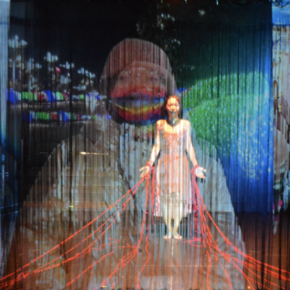
Kip Williams’s adaptation of The Maids at St. Ann’s Warehouse arrives at a moment when contemporary life increasingly feels organized through recursive systems of performance, spectatorship, aspiration, and enclosure. Genet’s 1947 play has always examined roleplay, class fantasy, domination, imitation, and the instability of identity. Williams’s production recognizes that these dynamics now operate through interfaces, platforms, and visibility economies that structure contemporary subjectivity itself. Rather than treating the digital world as topical decoration layered onto a canonical text, the adaptation reframes Genet’s ritual structures through the logic of platform culture, where the self is continuously performed, modified, circulated, and reflected back through systems that promise transformation while reinforcing dependency.
Watching the production, I kept thinking about what some online theorists have loosely described as “cuck internet theory,” the growing sense that users increasingly exist inside closed systems where platforms, influencers, advertisers, AI-generated content, and recommendation engines perform for one another in recursive loops designed primarily to sustain engagement, humiliation, and FOMO. Human beings remain inside these systems as labor, data, attention, and behavioral residue. Williams never names this condition directly, yet the production understands it deeply. Claire and Solange no longer appear simply trapped within the confines of bourgeois servitude. They resemble subjects attempting to negotiate identity inside systems where visibility itself has become labor and where performance increasingly feels inseparable from survival.
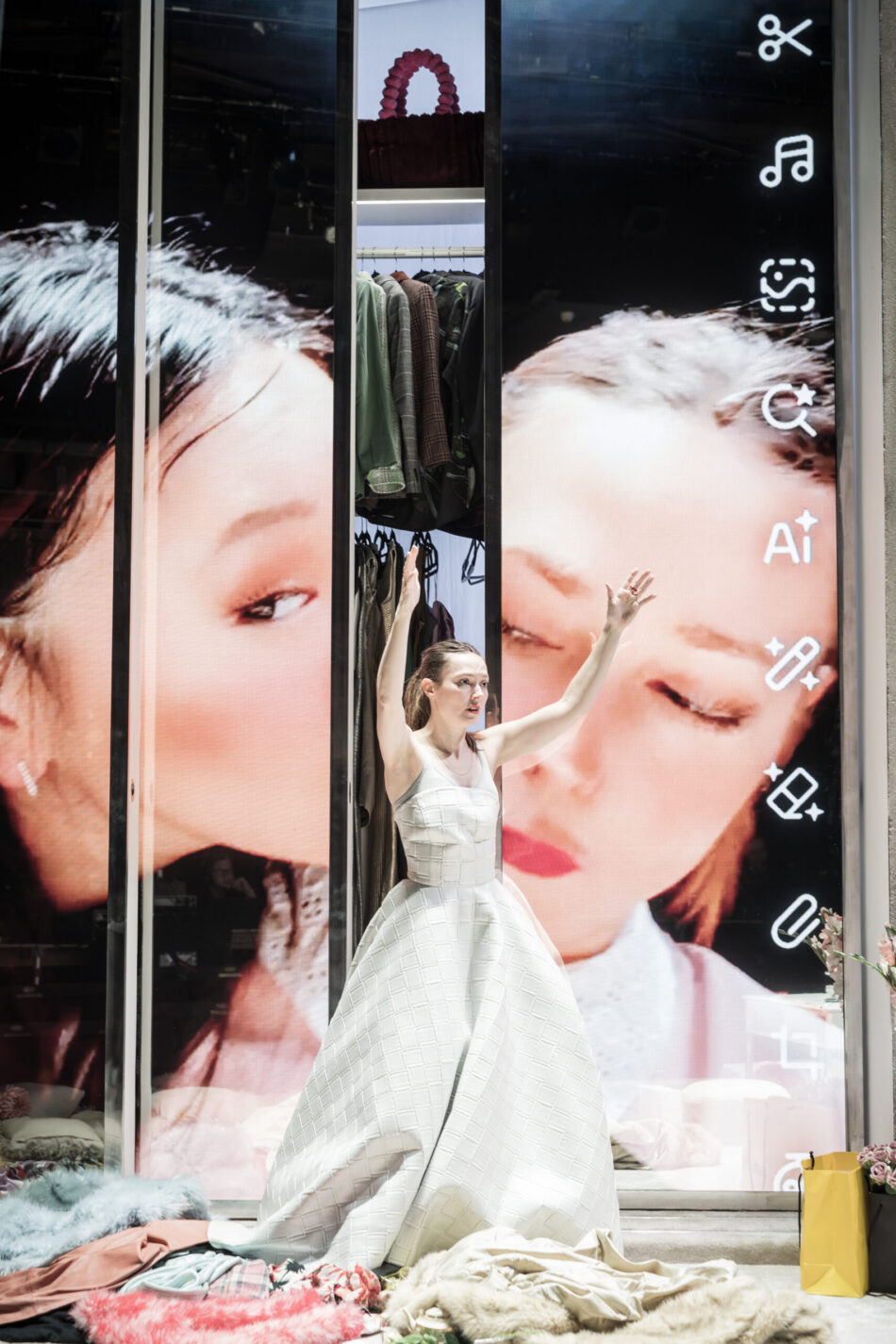
The production’s scenography makes this argument spatially concrete. The stage is dominated by a triptych of massive sliding mirror/video walls rising nearly sixteen feet high. These reflective surfaces function simultaneously as mirrors, screens, interfaces, portals, concealment systems, and architectural thresholds. Behind them sit one exit and closets packed with luxury goods, cosmetics, wigs, shoes, jewelry, and the endless accessories required for identity construction and maintenance. The walls slide open and shut with the frictionless precision of luxury interfaces, transforming the stage into a continuously shifting apparatus of reflection, surveillance, aspiration, and display. The result is less a domestic interior than a performative operating system where identity emerges through mediated surfaces.
Importantly, the production situates the physical world largely beyond reach. Exteriority arrives primarily through smartphones, notifications, projected imagery, and livestream aesthetics. Claire and Solange, performed by Lydia Wilson and Phia Saban in alternating desperate, hilarious, and devastating turns, create images of life rather than inhabiting life directly. The outside survives as representation. Williams constructs a world where the interface has replaced architecture itself, where subjects encounter reality through systems of circulation rather than material contact. The sisters can imagine escape, rehearse escape, aestheticize escape, and perform fantasies of liberation, yet every gesture remains trapped inside the representational machinery organizing their lives.
Madame’s role within this structure becomes especially important. Reimagined here as an influencer-adjacent oligarchic heiress and played to sublim manic frivolity and menacing terror by Yerin Ha. She moves fluidly between digital and physical space in ways unavailable to Claire and Solange. She alone possesses genuine mobility across thresholds. This distinction gives the production its sharpest class dimension. Wealth allows Madame to experience platforms as extensions of agency, while Claire and Solange experience them as total environments. They maintain the system, style the system, clean the system, and sustain the fantasy architecture surrounding Madame’s life without ever gaining access to the freedoms the system advertises. Their proximity to privilege intensifies their exclusion from it.
Williams’s use of mirrors extends this argument further. Genet’s original play already destabilizes identity through doubling, theatricality, projection, and ritualized imitation. Williams updates these mirrors into hybrid reflective interfaces where self-recognition becomes inseparable from systems of mediation and circulation. Claire and Solange rarely encounter themselves directly before their gestures return as reflection, image, projection, or performed identity. The production suggests that contemporary subjectivity increasingly emerges through recursive feedback systems where the self is experienced through visibility and repetition rather than interior stability. Reflection becomes operational. Identity appears continuously formatted through external systems of spectatorship and optimization.
This dynamic becomes especially visible in the sisters’ rituals of transformation. A lesser adaptation might frame these scenes primarily as expressions of envy, humiliation, or psychological instability. Williams understands something more complicated is unfolding. Claire and Solange do not merely reenact domination. They use performance as an attempt at rupture. Their repeated impersonations of Madame function as experiments in self-transformation, tests of new identities, rehearsals for escape, and efforts to imagine existence outside the structures confining them. Each ritual becomes an attempt to break through the roles assigned to them, though every attempt remains trapped inside the recursive systems organizing their desires.
That tension gives the production much of its emotional force. The sisters resemble subjects attempting to perform themselves out of enclosure while remaining dependent on the systems producing the enclosure itself. This dynamic resonates strongly with contemporary digital life, where social media performance often operates simultaneously as labor structure, survival mechanism, fantasy space, and attempted self-invention. Platforms encourage users to believe that sufficient visibility, optimization, circulation, and performance might eventually produce liberation. Williams’s production understands that these systems more often intensify dependency while disguising themselves as freedom.
The adaptation’s live camera work and projections intensify this sensation without reducing the production to technological spectacle. Faces appear enlarged, fragmented, filtered, delayed, and redistributed across the reflective architecture of the set. Bodies oscillate between physical presence and mediated circulation. Williams explored similar formal territory in his adaptation of The Picture of Dorian Gray, where live cinema fractured identity across multiple simultaneous selves. In The Maids, these techniques become less concerned with psychological fragmentation than with the social and economic organization of identity itself. The image systems structure labor, aspiration, class fantasy, and emotional dependency.
Importantly, the production implicates the audience within these systems of observation. Spectators become embedded inside the machinery of attention sustaining the sisters’ performances. Watching Claire and Solange spiral through increasingly unstable rituals begins to resemble the contemporary consumption of emotional escalation online, where breakdown, aspiration, humiliation, confession, and theatricalized self-exposure circulate continuously as content. The production never simplifies this relationship into moral accusation. Instead, it exposes how spectatorship itself now functions as infrastructural support for systems that intensify performance while absorbing resistance back into circulation.
Williams also avoids positioning technology as the singular source of alienation. The production remains grounded in Genet’s understanding of class, desire, dependency, and theatricality. Platforms and interfaces do not create these structures from nothing. They reorganize and intensify them. Claire and Solange remain materially trapped workers whose labor sustains the life of someone who moves freely through spaces they can only access indirectly. The production’s digital architecture sharpens this relation rather than replacing it.
At times, the production risks becoming consumed by its own aesthetic systems. The visual machinery grows seductive. The polished surfaces, projections, reflections, and mediated imagery occasionally threaten to overwhelm the human stakes unfolding beneath them. Yet this danger ultimately strengthens the production because it mirrors the exact condition Williams stages. Representation becomes self-reinforcing. Spectacle absorbs attention even while exposing its own violence. The audience experiences the seduction of interface culture while simultaneously witnessing the exhaustion and collapse produced by it.
What ultimately distinguishes the production is its understanding that Claire and Solange’s rituals are motivated less by the pursuit of domination than by the search for liberation. Their performances move toward annihilation because annihilation begins to appear as the only imaginable outside. If identity itself has become trapped inside recursive systems of imitation, circulation, and roleplay, then disappearance starts to resemble freedom. Genet’s play has always carried this impulse toward collapse, though Williams reframes it through contemporary structures of mediated identity and platform enclosure. Unlike digital systems that endlessly regenerate content through repetition, death interrupts circulation. It introduces irreversibility into systems organized around endless reproduction.
This gives the production genuine tragic force. Claire and Solange are not avatars operating inside consequence-free simulations. Their bodies remain present, vulnerable, exhausted, and destructible. Williams repeatedly stages the collision between liveness and interface culture, asking what forms of transformation remain possible within systems increasingly organized around recursive performance and spectatorship. Theatre matters here precisely because it still contains the possibility of risk, failure, disappearance, and irreversible consequence in ways contemporary platforms continually attempt to neutralize.
By the production’s conclusion, the sliding mirror walls no longer read simply as scenographic devices. They become materializations of contemporary life organized through reflective systems demanding continuous self-performance while concealing the political and economic structures operating behind them. Claire and Solange rummage through and claw at these surfaces searching for transformation, transcendence, escape, or rupture. Williams understands that this condition now extends far beyond Genet’s chamber drama. It has become one of the defining emotional structures of contemporary subjectivity itself.
Photography by Marc Brenner