Since 2017 the Norwegian theatre company Susie Wang has been building a distinctive body of work at the intersection of horror, fiction, and theatrical spectacle. Founded by Trine Falch, Martin Langlie, Mona Solhaug, and Bo Krister Wallström, the group emerged from Norway’s experimental performance scene with a deliberate move toward story-driven theatre after years of conceptual forms. Their productions, including The Hum (2017), Mummy Brown (2018), and Burnt Toast (2020), use practical stage effects, sound design, and darkly comic gesture to probe human nature and the “un-real”.
Susie Wang’s Burnt Toast at Skirball Center
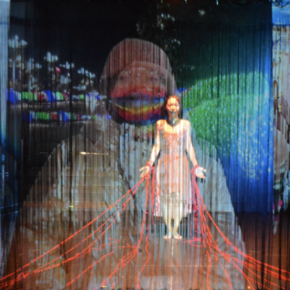
Is it a hotel? Is it Hell? Why is everyone obsessed and slurping on the complimentary eggnog drink? Burnt Toast at The Skirball Center in NYC, by the Norwegian company Susie Wang, opens inside an all-red hotel lobby that feels like No Exit or The Shining. The receptionist stands behind the counter, typing with hypnotic slowness on an unseen terminal, occasionally pausing to suck a hard candy. Two elevator doors glow on either side of her. Skin-toned beanbags fill the space like discarded organs. The sound design hums at a hyper-amplified register, so that each keystroke and swallow becomes unnervingly intimate, almost ASMR. Something is very wrong.
The sound design hums at a hyper-amplified register, so that each keystroke and swallow becomes unnervingly intimate.
Susie Wang’s world is meticulously artificial. Every surface feels cheap and dangerous, promising theatrical excess: plush red carpet, fluorescent lighting, mirrors gleaming. When the elevator finally grinds open, a man steps out dragging a rolling suitcase and a silver briefcase handcuffed to his wrist. His trousers are too tight, his posture too deliberate. He is part salesman, part specimen. The scene unfolds with excruciating patience. The two exchange greetings in a slow, off-kilter American Southern accent, each syllable tinged with a Norwegian undertone. Their conversation slips and slides into the uncanny.
At this point, Burnt Toast descends into pulp horror, surreal comedy, and psychological nightmare. A single mother with a newborn named Miracle enters the lobby. She strikes up a conversation with the man, who introduces himself as Dinny Iwas. She breastfeeds while he connects a feeding apparatus, a small tube from his silver briefcase to his mouth, and drinks an unknown liquid. She is also slurping the eggnog drink. The slurping is constant, and it’s a heavy foreshadowing for what’s to come. The woman’s C-section scar begins to bleed through her blouse. Dinny asks to look at it. The scene becomes the most horrific and foreboding meet-cute imaginable, sliding into a series of moments that are difficult to describe.
It unfolds like a Grand-Guignol fantasy of an American Southern Rom-Com
What follows plays out like a Grand Guignol fantasy of an American Rom-Com. Relationships collapse and reform in seconds. Time loops and jumps. The hotel becomes a site of ritual dissection. Bodies open, close, and are cut away. The mother’s wound becomes a doorway. The baby is sacrificed again and again, each version smaller than the last, until the final one, a speck named Hope, is sealed in a tiny ring box. It is grotesque, but also absurdly tender. The audience laughs, then recoils, or vice versa.
Susie Wang’s craft lies in the precision of these morphing relationships and theatrical sleights of hand. The lighting and sound design operate as sculptural tools. There is slurping, cutting, blood, and a love story. The performance’s horror is built on theatrical rhythm, the stillness before movement, the delayed reaction, the held breath. The characters grasp at each other emotionally and physically. The red hotel becomes a living organism, digesting its characters and spitting them out as mythic residue.
The red hotel becomes a living organism, digesting its characters and spitting them out as mythic residue.
What emerges is a meditation on consumption and reproduction, on how desire, motherhood, and mortality fold into one another through the negotiations of relationship and need. The grotesque is necessary in this world. Every incision reveals a strange beauty in exposure and an absurd humor in our limits. Burnt Toast reconstructs the artifice of horror from the inside out. By the end, nothing remains but Hope.
Check out more reviews here –>
CREATIVE CREDITS Betty: Julie Solberg Danny: Kim Atle Hansen Violet: Mona Solhaug Script and Direction: Trine Falch Scenography: Bo Krister Wallstrøm Music and Sound Design: Martin Langlie Lighting Design: Phillip Isaksen SFX: Fanney Antonsdottir Stagecraft, design: Antti Bjørn, Jon Løvøen Stagecraft, live: Simen Ulvestad, Oscar Solløs, Viola Hamre Accent coach: Sarah Valentine
Photo: Alette Schei Rørvik