
New York Live Arts Theater December 3-6 & 10-13, 7:30pm
Tere O’Connor’s program at New York Live Arts brings together Construct-a-Guy (1984) and the world premiere of The Lace, offering a rare opportunity to encounter forty years of choreographic thinking in direct conversation. O’Connor has long treated dance as an autonomous system, a place where movement exists after language, and where meaning unfolds through sequencing, rhythm, and the accumulation of disruption and tangent. Across these two works, he returns to strategies that shaped his early career, reframes them through decades of practice, and probes how choreographic structures form, destabilize, and recombine in relation to queerness, perception, and lived complexity.
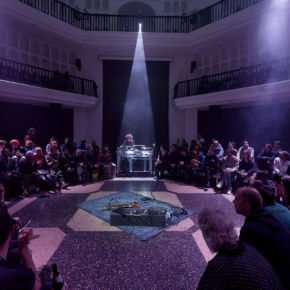
Construct-a-Guy, performed by the phenomenal Tim Bendernagel, retains the unruly vitality of its original presentation 40 years ago. Capricious rhythmic change, spatial fragmentation, and sudden shifts of sensibility form a composition that refuses hierarchical ordering. The piece arrives as a rapid collision of references and citations, both formal and quotidian. Movement veers from flirtation to opacity, from complex footwork to casual gestures. Moments spark associations with a vast history from Cunningham, Balanchine, Graham, Childs, and the queer sociality of downtown dance, but each echo appears only long enough to be disrupted.
“Movement veers from flirtation to opacity, from complex footwork to casual gestures.”
The work’s volatility reflects what O’Connor later described as the “closeted mind,” a survival architecture formed during his childhood and teenage years and later realized during the act of coming out in the early 1980s. According to his talk between pieces, he describes the closeted mind as multiple figures inside a single consciousness, including the enforcer, the analyst, and the strategist, each policing and adjusting the body at high speed . This description sits within a wider field of thought that examines divided perception. W. E. B. Du Bois articulated a related dynamic in his theory of double consciousness in The Souls of Black Folk (1903), a concept that captures the lived condition of holding an inward sense of self while simultaneously being registered through the eyes of a dominant, oppressive culture. Although emerging from different histories and contexts, both frameworks illuminate the ways internal multiplicity forms under pressure. Each describes a perceptual architecture shaped by vigilance, self-monitoring, and continual recalibration of presence. O’Connor’s choreography translates this condition into motion, where rigor, multiplicity, strategic tangent, and queer complexity collide. This mental choreography becomes the engine of the dance. Sequencing tilts, cuts, and pivots. Tangents gather force. The dance never settles into wholeness; it thrives in the sidelong.
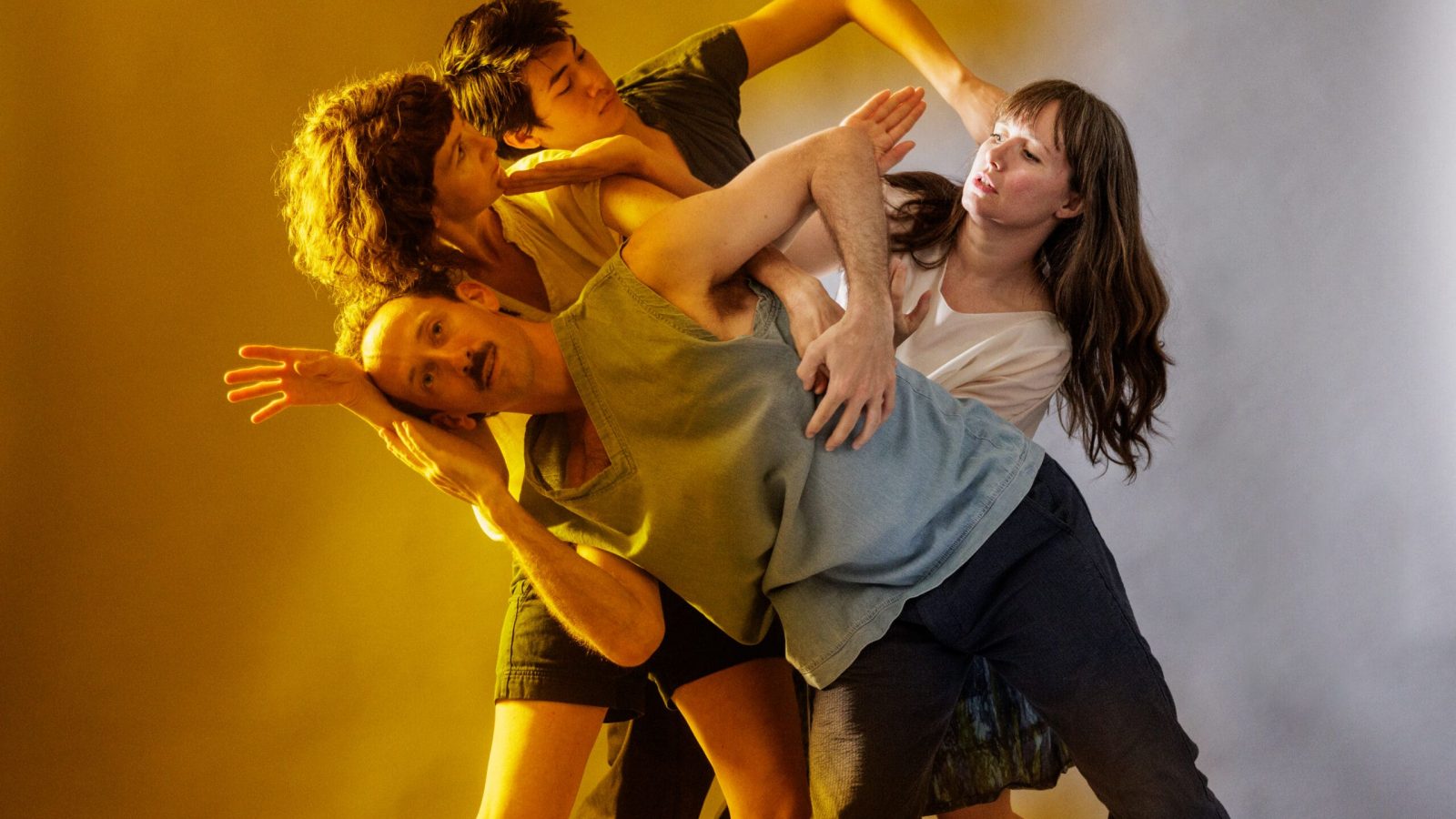
The Lace takes this early set of concerns and stretches them across a larger ensemble. The cast moves through shifting patterns where timing, proximity, and relational density form the work’s structure. O’Connor’s sequencing strategies appear in expanded scale: events accumulate, dissolve, and reconstitute themselves. Gestures thread through bodies and then weave through the group. The choreography generates meaning through adjacency rather than illustration. Like Construct-a-Guy, the work approaches dance as a post-linguistic expression driven by the strategies first articulated in that early solo and expanded through decades of inquiry, a space where vigilance, rigor, and continual recalibration intertwine with joy, community, and hope, folding into one another and expanding outward.
“This mental choreography becomes the engine of the dance.”
The performers sustain this architecture with striking clarity. Their attention to weight, tempo, and micro-adjustment allows O’Connor’s intricate sequencing to remain legible without becoming rigid. Small shifts in focus ripple through the group. The dancers hold the material with precision while allowing for the porousness the work requires, where relationships form and dissolve in real time. Their labor reveals a collective intelligence shaped through years of shared practice.
“The dancers hold the material with precision while allowing for the porousness the work requires.”
O’Connor framed the evening as an inquiry into consciousness and its structures, and this becomes central to the experience of The Lace. Movement operates as thinking. His choreographic technique emerges from the interplay of the past and a speculative future. His discussion of surviving oppressive frameworks, the patterns that reinforce normative narratives, casts new light on the dance’s strategies. The work reorganizes expectation. It places tangential action at the center and frees the dance from familiar arcs of development or resolution. The choreography becomes a site where other modes of togetherness can be imagined.
Across his career, O’Connor has resisted labels like avant-garde or experimental, arguing that such terms marginalize practices that diverge from conventional narrative or aesthetic frameworks. This program demonstrates the clarity of that position. Construct-a-Guy and The Lace form a continuum. The earlier work reveals the seeds of O’Connor’s craft: rhythmic dissonance, conceptual layering, and the refusal of prescribed structure. The new work reveals how those seeds have grown into a complex system of choreographic thought, one that considers consciousness as a choreography of attention, drift, and disruption. O’Connor’s contribution to the field continues to reside in his commitment to dance as an art of multiplicity, where the intangible states of life become material.
What remains after the program is a sense of continuity across time. The dances share a profound compositional logic, one shaped by decades of observation and inquiry. O’Connor’s work invites audiences into this logic, asking them to participate in the assembly of meaning rather than receive it. In doing so, the evening affirms the vitality of dance as a form that generates new ways of perceiving, thinking, and being together.
Photo: Maria Baranova
Credits:
Construct-a-Guy (1984)
Performer: Tim Bendernagel
Lighting Design: Michael O’Connor
Music: Diane Martel
The Lace (2025)
Performers:
Heather Olson
Natalie Green
Aaron Loux
Gabriel Bruno Eng Gonzalez
Liony Garcia
Tim Bendernagel
Sound Score: Tere O’Connor
Lighting Design: Michael O’Connor
Costumes: Harriet Jung and Reid Bartelme