
Isa Spector’s Real Estate at The Brick in Brooklyn begins with a proposal familiar enough to any New Yorker to feel almost mythic in its futility. Two gay Brooklyn guys meet, and one of them is moving apartments. It is a Sisyphean task, one experienced over and over by anyone who has tried to establish a life in New York. Everything must be packed, carried, moved, and reassembled. Spector takes this constant state of moving as both the circumstance of Real Estate and its formal condition. People move apartments, move toward and away from one another, move through sex and relationships, and move through versions of themselves. Nothing stays exactly where it was put.
Created by Spector, Real Estate puts text, gesture, and choreography on different tracks, slipping against a shared timeline. They align, contradict one another, get caught in strange poetic standoffs. A gesture can play the psychology of the text and then suddenly have nothing to do with it. At other times, the movement pulls the whole scene toward abstraction before the text jump-cuts us somewhere else. Meaning gets made and undone in the gaps.
This slippage is central to Spector’s practice. Working between dance, theater, and performance, Spector has described an ongoing interest in negotiating text and movement, allowing each to alternately lead, disrupt, or complicate the other. In Real Estate, that formal investigation is embedded within the recognizable social world of contemporary queer Brooklyn. Spector has also spoken about architecture and site as a starting point for narrative, imagining the characters who might inhabit a particular space and allowing movement to emerge from within that dramatic world. Here, the apartment becomes more than setting. Real estate is property, location, body, relationship, and the precarious territory one person attempts to occupy in the life of another.
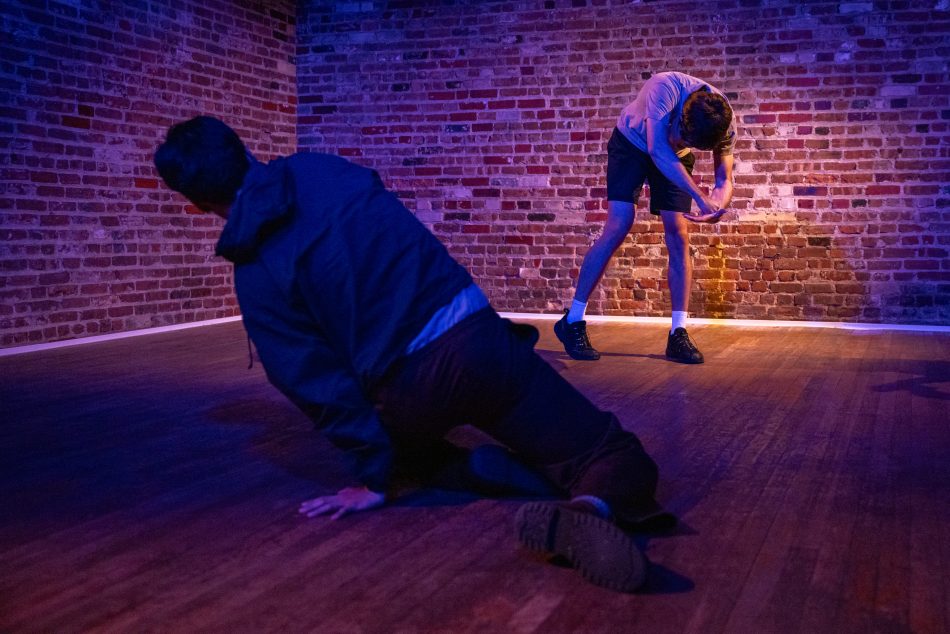
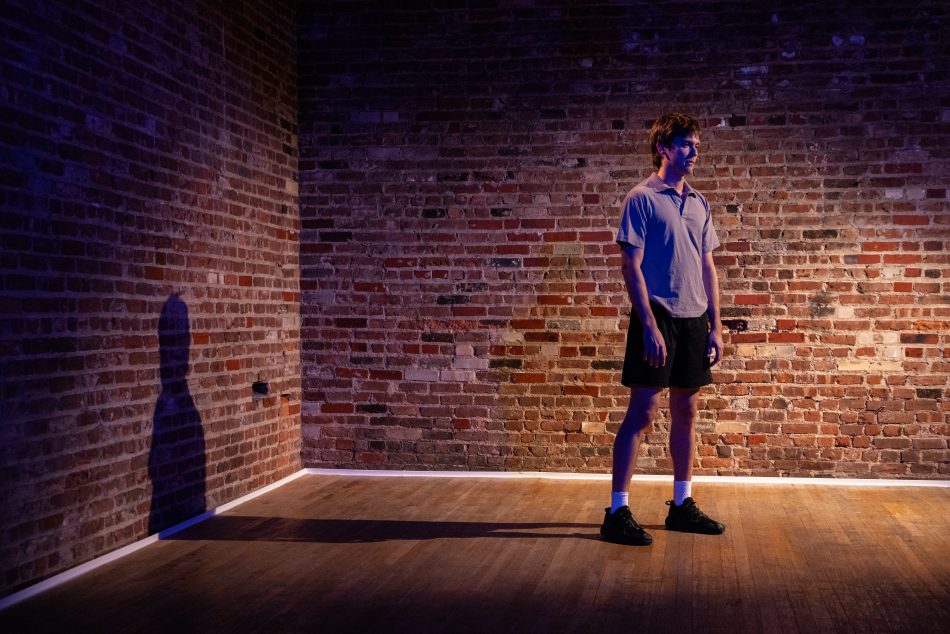
Ari Dalbert and Sheldon Donenberg create puckish, lonely embodiments of the ur-Brooklyn gay bro, a combination of stoicism, practiced casualness, and desperate longing. There is sexual tension between them and the possibility of something riskier, emotionally. Their relationship tests, turns, and untangles as the performance unfolds. They are frequently alone, even when together. A particularly funny Bushwick orgy leaves us with the inverse of Lucky Pierre, the lonely body somehow stranded at the edge of sexual abundance.
Real Estate is outwardly very funny. It is playful, quick, and surprising. Underneath that surface is a more troubled landscape these guys are attempting to navigate. The long shadow of patriarchy and masculinity blots out genuine need, trauma, and desire. Run-ins, hookups, fast sex, apartments, bodies, and constant moving provide ways to keep circulating without necessarily arriving anywhere. Spector’s formal slippages begin to tear at this rom-com veneer. Every time the relationship threatens to become legible, the performance shifts its terms.
The technique places a considerable demand on Dalbert and Donenberg. Because text, gesture, and movement do not necessarily occupy the same expressive register, the performers must split their attention across several systems of meaning. They ride psychological intention while simultaneously executing a physical score that might amplify, displace, or contradict it. The result becomes a concrete performance proposal for double consciousness and hypervigilance. The performer-character must navigate action, meaning, and the outward perception of both. Dalbert and Donenberg athletically jockey among sincerity, dissimulation, rawness, affectation, and terse abstraction, sometimes all at once.
This formal strategy places Spector in conversation with artists whose practice also pulls language and movement apart. Toshiki Okada and his company chelfitsch have developed a theatrical language in which speech and gesture occupy related but deliberately unsynchronized systems. In the work of Vienna-based choreographer Philipp Gehmacher, gesture itself becomes a field of articulation, capable of carrying meaning without settling into illustration. Real Estate shares something with these practices, while Spector puts the separation of body and language to a different use. The distance between what is said, what is performed, what is felt, and what can safely be revealed becomes socially and psychologically charged.
Mikelle Kelly’s lighting is precise, cinematic, abstract, and constantly surprising. It can suddenly destabilize and reorganize what we think we are watching. Asa Levite‘s sound shifts between interstitial scoring, cinematic underscoring, abstract room tones, and pedestrian soundscapes. At times, the elements lock together; at others, they seem to pull against one another. The room around Dalbert and Donenberg keeps being made and unmade.
Everything is wound tight. The apparent casualness depends upon exacting articulation from performers and designers alike. Spector repeatedly constructs something recognizable, a meet-cute, a hookup, a friendship, a romance, a gay bro, an apartment, and allows us to inhabit it just long enough for its coherence to become suspect. Just as something starts to make sense, Spector undoes it. The work keeps catching meaning in the act of changing.
That continual undoing and remaking gives Real Estate its emotional and intellectual force. Beneath all the movement is a question of where, and with whom, these men might finally stop moving. The answer never quite settles. Desire remains entangled with its performance, intimacy with its avoidance, masculinity with the vigilance required to maintain it. Spector leaves those tracks running beside one another, occasionally touching, then contradicting. Toward the end, the encounter is stripped to its starkest form, looping through light and blackout, contact and separation. It repeats until it doesn’t or can’t anymore.
Written, Choreographed, and Directed by Isa Spector
Featuring Ari Dalbert and Sheldon Donenberg
Sound Design by Asa Levite
Lighting Design by Mikelle Kelly
Stage Manager: Amanda Reynoso
OF THE FIELD.