Home Blog Page 160

P4M.Online.Video.Festival.DAY05: David Levine (Berlin, Germany), Jérémie Dres (Paris, France)

p4m.pvf.logolong

Contemporary Performance is hosting an online video festival of performance works and excerpts from 06.14.2010 to 07.02.2010. We’ve curated some of our favorite user submissions and online videos from today’s leading contemporary artists and embeded them here. The videos range in purpose and content and include rehearsal videos, process videos, performance documentation, lectures, made for video, dance on camera, video art, and vj.

DAY 05

David Levine (Berlin, Germany)
BAUERNTHEATER

In BAUERNTHEATER, an American method actor, who knows no German, trained to play the role of Flint, a farmer in Heiner Müller’s GDR agricultural drama, “Die Umsiedlerin.” After 3 weeks of rehearsal in a studio in Brooklyn, he was flown to rural Brandenburg, where the play is set, given 2 acres of land and 1 ton of potatoes, and asked to be “in character” for 10 hours a day, 5 days a week, for a month, planting the entire field by hand as someone else. Shot in a mix of documentary and cinematic styles, the Bauerntheater film depicts rehearsal and performance, and is its own meditation on acting, authenticity, and labor.

David Levine’s work examines the conditions of spectacle and spectatorship across a range of media. His performances, installations, videos and theater pieces have been exhibited internationlly, from Town House gallery in Cairo to Documenta XII to the Sundance Theater Lab. He will be a featured artist at MoMA’s Symposium: Audience Experiments, and just finished a two-week residency at Robert Wilson’s Watermill center for HABIT, a commission from Toronto’s Luminato Festival.

Jérémie Dres (Paris, France)
Les Hauts de Plafond on Tablographie

Tablographie is a real time visual program which interacts with soud sources.
The performer create landscape in real time composed of organisms built in codes. It s real life video program which is played in association with musicians.

Jeremie Dres is a young artist who works in the new Media Art. Most of his works explore the artificial life of visual organisms generated by computers and how it can behave with some external input such as microphone. He is also interested in the meeting of generative poetry and numeric art.

P4M.Online.Video.Festival.DAY04:Romeo Castellucci – Socìetas Raffaello Sanzio (Italy) NSYW

p4m.pvf.logolong

Contemporary Performance is hosting an online video festival of performance works and excerpts from 06.14.2010 to 07.02.2010. We’ve curated some of our favorite user submissions and online videos from today’s leading contemporary artists and embeded them here. The videos range in purpose and content and include rehearsal videos, process videos, performance documentation, lectures, made for video, dance on camera, video art, and vj.

DAY 04

Romeo Castellucci – Socìetas Raffaello Sanzio

Born in 1960 in Cesena, Castellucci graduated in stage design and painting at the Academy of Fine Arts in Bologna. In 1981, he founded the Socìetas Raffaello Sanzio together with Claudia Castellucci and Chiara Guidi. In the beginning of the 80’s he focused his interest on theatre and painting, also giving some exhibitions.

Considered to be a trailblazer of avant-garde theater in Italy, Castellucci presented several performances as an author and director, also creating sets, lights, sounds and costumes. Known as an author of a theatre addressed to a “total” perception, he has written several books about dramaturgy. In 2005 he was appointed as the director of the Theatre Section of the 37th Venetian Biennale, and in 2008 he was an Associate Artist of the Avignon International Festival. Among his representative works are “Hamlet. The vehement exteriority of a mollusc’s death” (1992), “Oresteia (an organic comedy?)” (1995), “Julius Caesar” (1997), “Genesis. From the museum of sleep” (1999), “Voyage au bout de la nuit” (1999), “Il Combattimento” (2000), “Tragedia Endogonidia” (2001-04), “Hey Girl!” (2006), and Dante’s La Divina Commedia: “Inferno”, “Purgatorio” and “Paradiso”.

Romeo Castellucci.
P.#06 Paris

(I saw this live and it contains one of the most surprising moments I have every witnessed as an audience member. It comes at the end of this clip)

Romeo Castellucci
Tragedia Endogonidia #01 Cesena 2/2

Socìetas Raffaello Sanzio
Genesi from the museum of sleep – Parte I – Scena di Lucifero

Romeo Castellucci
M.#10 Marseille

P4M.Online.Video.Festival.DAY03: Kalup Linzy (USA), Ryan Trecartin (USA)

p4m.pvf.logolong

Contemporary Performance is hosting an online video festival of performance works and excerpts from 06.14.2010 to 07.02.2010. We’ve curated some of our favorite user submissions and online videos from today’s leading contemporary artists and embeded them here. The videos range in purpose and content and include rehearsal videos, process videos, performance documentation, lectures, made for video, dance on camera, video art, and vj.

DAY 03

Kalup Linzy (USA)
All My Churen (2003)

Second installment of the churen series and the debut of the Braswell family played by Kalup Linzy. Kalup Linzy (born July 23, 1977) is an American video and performance artist who lives and works in Brooklyn, New York. Born in Clermont, Florida, Linzy graduated from the MFA program at the University of South Florida in 2003. He also attended the Skowhegan School of Painting and Sculpture video art workshop, and in 2005 received a grant from the Louis Comfort Tiffany Foundation. Linzy was named a Guggenheim Fellow in 2007. Linzy’s best known work is a series of video art pieces satirizing the tone and narrative approach of television soap opera.[citation needed] Linzy performs most of the characters himself, many of them in drag. He also performs many of the same characters on stage. Linzy’s work has been reviewed in The New York Times, Art in America, and Artforum.

Ryan Trecartin (USA)
I-BE AREA (Pasta and Wendy M-PEGgy)

Ryan Trecartin (b.1981, Webster, Texas) is a filmmaker and artist based in Philadelphia, Pennsylvania. recartin’s work has been exhibited at The Moore Space in Miami and the Getty Center in Los Angeles Getty Center and at the Penrith Regional Gallery in Australia. Reckless Behavior (video). April 19, 2006. Retrieved September 22, 2008.. He participated in the 2006 Whitney Biennale at the Whitney Museum of American Art, and the “USA Today” exhibition at The Royal Academy in London. Trecartin was included in the 2006 Wall Street Journal article titled “The 23-Year Old Masters,” which selected ten top emerging US artists including Dash Snow, Rosson Crow, Zane Lewis, and Keegan McHargue. His work is featured in the Saatchi Gallery collection. He is represented by Elizabeth Dee Gallery in New York.
In 2009, he became the first recipient of the Wolgin Prize awarded by Tyler School of Art.

P4M.Online.Video.Festival.DAY02: Controllar (Netherlands), John Jahnke/Hotel Savant (USA)

p4m.pvf.logolong

Contemporary Performance is hosting an online video festival of performance works and excerpts from 06.14.2010 to 07.02.2010. We’ve curated some of our favorite user submissions and online videos from today’s leading contemporary artists and embeded them here. The videos range in purpose and content and include rehearsal videos, process videos, performance documentation, lectures, made for video, dance on camera, video art, and vj.

DAY 02

Controllar (Netherlands)
Anat Spiegel & Thomas Myrmel STEIM 2009

Controllar, art-pop duo of Thomas Myrmel & Anat Spiegel, spent two weeks in residency at STEIM, studio for electro-instrumental music in Amsterdam. The focus of this residency was to further develop the unique combination of vocals and electronics used in their live performance. Filmed and edited by Vivian Wenli Lin.

John Jahnke/Hotel Savant (USA)
The Archery Contest

The Party: Two teenagers are invited to the Reverend Kendrick’s home to celebrate an unnamed festivity. The Reverend’s wife does her best to entertain in a wholesome fashion, though the purpose of their invitation seems oddly licentious. Filmed at Performance Space 122, October 2009. Developed at 3LD Art and Technology Center. The document was filmed in performance and features Alexander Borinsky, Hillary Spector, Richard Toth, Carey Urban and Jeff Worden. Script, Direction, Design by John Jahnke. Set Design Peter Ksander. Sound Design Kristin Worrall. Lighting Design Miranda Hardy. Video Design Andrew Schneider. Costume Design Carlos Soto.

The Hotel Savant, a theatre company based in New York City, explores the livid, the uncertain, the magical and sublime: the seminal ideologies of history and mythology and their impact on contemporary narrative. Committed to mounting or developing one original work per year, they utilize a variety of performance techniques that include pageantry, dance and tableau. In addition they are dedicated to reviving obscure and rarely performed texts that correlate to present day topics. Utilizing visuals to explore the inherent root of a text, the company actively employs artists and designers with visionary interest, whose goal is to redefine standards of theatrical language and design. Works include The Archery Contest, Performance Space 122, 2009; Antonin Artaud’s The Cenci, The Ohio Theatre, 2008; Susan Sontag’s A Parsifal, Performance Space 122, 2006; Funeral Games (performance workshop), The Public Theater, 2004; The Shady Maids of Haiti, Walkerspace, 2002; Mercurius, HERE, 2001; and Lola Montez in Bavaria, HERE, 1999.

P4M Online.Video.Festival: Meg Stuart (Belgium), les ballets C de la B / Alain Platel (Belgium)

p4m.pvf.logolong

Contemporary Performance is hosting an online video festival of performance works and excerpts from 06.14.2010 to 07.02.2010. We’ve curated some of our favorite user submissions and online videos from today’s leading contemporary artists and embeded them here. The videos range in purpose and content and include rehearsal videos, process videos, performance documentation, lectures, made for video, dance on camera, video art, and vj.

DAY 01

Meg Stuart (Belgium)
BLESSED


The American choreographer and dancer Meg Stuart and the Portuguese choreographer and dancer Francisco Camacho met in New York in 89. He followed her to Belgium to dance in her debut work Disfigure Study. After that each went their own way but now theyre collaborating once more. Meg Stuart has choreographed BLESSED, a new piece with Francisco Camacho in a sound design by Hahn Rowe. In a corner of the world a man has created his own little paradise. How fragile are our mental constructions? How much illusion do we need to survive? Is mankind capable not to believe? Or is it the luxury of the privileged to escape in pipedreams? Is hope a matter of circumstances?

les ballets C de la B / Alain Platel (Belgium)
Out of Context – for Pina


Nothing up their sleeves, and nothing in their pockets. With Out of Context, director Alain Platel aims to return to the fundamentals of dance. Starting from a belief in the human body as emotional tool, as carrier of memories, as raw material for living fine art. While Platel has flirted with the boundaries of opera over the past years, with for example vsprs or pitié!, Out of Context is not a music-driven piece, and also has no set or costumes other than those the dancers can fit in their suitcases. It is however no crisis piece. It is in self-limitation that a master first shows himself. The mastery of the dancers with which Platel embarks on this adventure is indisputable. Each and every one is an impressive figure with whom Platel has travelled far over the years.

Danced and created by:
Elie Tass, Emile Josse, Hyo Seung Ye, Kaori Ito, Mathieu Desseigne Ravel, Mélanie Lomoff, Romeu Runa, Rosalba Torres Guerrero, Ross Mc Cormack

Highlights: Szene Salzburg Festival June 8-17, 2010 (Austria)

daniel aschwanden / peter stamer (vienna/berlin)
the path of money
friday, 09.07.2010 | 19:30 to friday, 16.07.2010 | 21:00

© Artist

in june, 2009 daniel aschwanden, yanfeng pei and peter stamer used their video cameras to accompany a chinese banknote on its way through china, thus also getting to know the people who spent it. with every completed transaction the three travellers changed their owner together with the bill. aschwanden and stamer record their encounters and delved into the lives of more than 30 people: what kind of a people is it that spends the “renminbi”*, the “money of the people”?

in june, 2010 the three continue their project in salzburg. they feed a marked 10 euro bill into the money flow of salzburg and follow it on its way to places and people. just like the two european performers were able to get their own view of china with the help of yanfeng pei’s translating skills, aschwanden and stamer now assist the chinese artist on his expedition – as interpreters and documentary filmers. the impressions recorded and images taken in china and austria will be presented scenically and as an installation from july 9 in the kavernen which were designed by the visual artist paul horn. the artists will be present.

from june 21, the journey of the banknote can also be followed on twitter under “thepathofmoney”.

iffat fatima (india)
ethnography of a european city:
conversations in an indian restaurant in salzburg
friday, 09.07.2010 | 19:30 to friday, 16.07.2010 | 21:00

© Artist

in her video installation “ethnography of a european city” the artist and documentary filmmaker iffat fatima, a native of cashmere in india, hits the streets of salzburg, accompanying an african asylum seeker, austrian street sweepers, tourists, artists and polyglot citizens of salzburg. as a non-european, fatima focusses on salzburg as a destination for those who are searching for the epitome of a traditional european city. this outsider’s perspective creates a fruitful discrepancy between the observer and the observed.

diego gil (buenos aires)/
tarek atoui (lebanon) /
sead dancers (salzburg et al.)
kapitel tanz outdoor
friday, 09.07.2010 | 21:30

©roberta marques

in salzburg, the art form dance is leading a rich life: practical and theoretical training, dance festivals, a variegated dance scene. this year’s sommerszene has placed a unique dance event for salzburg into the city. 50 young dancers from all over the world who live in salzburg and are trained at sead play on kapitelplatz, one of the city’s pittoresque architectural peculiarities.
the choreographer of the spectacle, diego gil comes from argentina, where dancing is an important part of the attitude towards life. he has developed movement patterns whose multiplicity and dynamics not only accentuate each dancer’s individuality, but also create an impressive overall picture. gil has worked with the young dance artists on outdoor over half a year, and developed a concept to become the exceptional dimension of a choreography for 50 dancers. the dance artists are accompanied by the lebanese composer and music performer tarek atoui, whose electronic sound cascades are activated by his movements: a highly theatrical process of unforgettable originality.
the aestival dance spectacle in front of the scenery created by fortress and dome is a statement on behalf of contemporary dance in salzburg.

caden manson / big art group (new york)
die salzburger
thursday, 08.07.2010 | 21:30

© Theo Kogan
© Theo Kogan

what do the salzburgers think about salzburg? how do social communication, neighbourhood, a democratical process work in this city? questions concerning our daily reality are put into focus by a dense and diverting visual-theatrical event next to the façade of the salzburg residence.

the form of the spectacle is uncommon, a kind of living television, a comprehensive large-scale display of our city, a projected televisual work of art in public space. the piece employs means like video clip, live action, live music and live broadcast from the salzburg residence, interviews, pictures of the city, re-enactment of public situations as well as contributions by the population of salzburg. the performance draws its power from the unique combination of film, theatre, music and action with the location. die salzburger is inspired by greek tragedy, aeschylus’ oresteia, which thematises questions regarding government, the development of legal relationships, democracy and social dialogue. because of the central participation of 40 salzburgers of various social backgrounds, the performance grants a unique view of salzburg.

this exceptional and irretrievable event was created by the visual and dramatic artists of the big art group from new york, who scrutinise the relationship between the individual and its society with the help of refined arrangement and technology. the music comes from the outstanding pop singer and dancer farrad from new york.

die salzburger is part of the big art group’s large-scale project the people,
and can also be seen as an installation named chapter 1 in the exhibition identity scan salzburg at republic.

following the performance sommerszene, the trumer brewery and the company wiberg invite for an opening party in the residence yard.

ultima vez / wim vandekeybus / mauro pawlowski (brussels)
what’s the prediction? the salzburg event
saturday, 10.07.2010 | 21:00

©pieter-jan de pue

a special ambience for a special artist: wim vandekeybus, frontman of contemporary european dance for over 20 years and uncompromising prophet of the power of movement, stages a fast-paced spectacle between dance, theatre, film and music specially for the jedermann stage on domplatz. with dancers from his company ultima vez he creates a flood of images that breaks over the audience with virtuoso acrobatics, passionate lust for movement and exploding visuals.

these tableaux vivants are borne by the powerful live music of mauro pawlowski, one of the wild eccentrics of the belgian cult band deus, with whom vandekeybus has also worked together in his last theatre production nieuvzwart. in salzburg he can be experienced with his own band pawlowskis, and highlight the lively stage performance with captivating funky rock’n’roll sounds.

The full Szene Festival program can be seen at http://www.szene-salzburg.net/index.php?id=205

In Performance: SCHWARZE JUNGFRAUEN June 2-5, 2010 (Berlin)

SCHWARZE JUNGFRAUEN

by Feridun Zaimoğlu and Günter Senkel
Directed by Neco Çelik
Ballhaus Naunynstraße
Repeat performance 2 – 5 June 2010 at 8:00 pm

Die Schwarzen Jungfrauen stehen wie ausgestellt einzeln in ihren Zellen. Das macht Anspielung auf den Voyeurismus der Mehrheitsgesellschaft auf die Minderheiten © Hülya Gürler

The stage premiere of the Kreuzberg filmmaker Neco Çelik is based on a series of interviews Feridun Zaimoğlu and Günter Senkel conducted with young Muslim converts in Germany. The women they meet want nothing less than the perfect symbiosis of sex and Islam and humbly conclude that naked does not equal pagan and being bandaged from top to toe is not always a complete negation of worldly interests.

Premiered in 2006, the play caused an uproar, made it to the front page of Theaterheute and was invited to the Mühlheim Theatre Days.

“The play lets the women speak for themselves: they are candid, articulate, well-educated, energetic, self-confident and, well, dangerous. These young virgins should certainly be ’handled with care’.”
K. Riesselmann, TAZ

Starring
Javeh Asefdjah
Nermin Çelik
Melek Erenay
Pınar Erincin
Katja Zinsmeister

UA Hebbel am Ufer for Beyond Belonging – Migration² by Shermin Langhoff (March 2006).
Repeat performance stage in cooperation with Ballhaus Naunynstraße and Hebbel am Ufer.
Performing rights: Rowohlt Theater Verlag Reinbek bei Hamburg.

In Print: Yale Theater Journal Publishes Scripts of Big Art Group and Nature Theater of Oklahoma

Nature Theater of Oklahoma’s Romeo and Juliet and Big Art Group’s SOS have been published in the new issue of Theater Journal. The issue focuses on the changing nature of playwriting, the impact of the economic crisis on theater in the US and Grotowski’s anniversary in Poland.

cover

Below is a quote from the editor, Tom Sellar, about the published texts and the larger issue of publishing new playwriting.

Is all writing for the stage necessarily playwriting? What should we call the collection and arrangement of found texts — a strategy embraced by the first Internet generation, raised on pastiche and now testing its capacities onstage? Or words created by some process of research, improvisation, or collaboration that — deliberately or unknowingly — disregards constituent elements of dramatic form?

This issue began as a simple collection of enthusiasms: the two American scripts it contains, performed in 2008 and 2009 by Big Art Group and Nature Theater of Oklahoma, reflect the linguistic, thematic, and structural creativity of New York’s reinvigorated self-producing ensembles. But these two projects, shaped and defined by innovative collaborative models, led us to contemplate other questions about the evolution and fate of playwriting: what exactly does it mean to publish a script at a moment when print can no longer claim to guarantee dissemination of an artistic expression…

– Tom Sellar, Theater Journal 40:2 doi 10.1215/01610775-2009-024

© 2010 by Yale School of Drama/Yale Repertory Theatre

Table of Contents:

Up Front
Tom Sellar
Tanya Dean
Juliana Francis Kelly

A Crisis of Purpose? A Forum
Compiled and introduced by Ryan M. Davis

The Booking of the Play
George Hunka

Babes in the Woods: Big Art Group’s SOS
Jacob Gallagher-Ross

SOS
Big Art Group

Uncreative Writing: Nature Theater of Oklahoma’s Romeo and Juliet
Karinne Keithley

Nature Theater of Oklahoma’s Romeo and Juliet
Nature Theater of Oklahoma

Books
Alan Ackerman on The American Play: 1787 – 2000

Productions and Events
Kathleen Cioffi on Year of Grotowski
Stephen Nunns on Grotowski’s Local Legacies
Miriam Felton-Dansky on Chautauqua! and The Provenance of Beauty

New Links in Artists, Festivals, and Writings

Artist and Companies

Ane Lan , Kløfta, Norway
Homepage of Norwegian performance artist Ane Lan

Antonio Tagliarini (Rome, Italy)
Italian performer who’s work is developed between dance and theatre.

Band of Bless (Montreal, Canada)
Performance artist Dana Michel.

Writings and Blogs

Anna Monteverdi _LA SPEZIA (Italy)
Blog on Digital Performance with many resource links (Groups, Multimedia artists data base)

Festivals

Alkantara Festival (Portugal)
International performance festival that also hosts many meetings, residencies, and national and international co-productions

Festival TransAmériques (Montréal, Canada)
National event celebrating new works in contemporary dance and theatre, the Festival TransAmériques combines disciplines and artistic trends under cohesive programming.

Submissions

If you would like to submit a website to be included in the links pages of Contemporary Performance, please fill out the form below. The links pages of Contemporary Performance are curated with an international scope.

In general, we prefer to list:

  • Artists that have toured to at least three other countries besides their home country
  • Venues with a a focus on international presentation
  • Festivals that present at least two artists from a different country
  • Writings and Blogs can be about the general field of contemporary performance and may be more locale specific

[link-library-addlink settings=1]

Featured: Brut Wien – Queerograd 05.27-05.29.2010 (Vienna, Austria)

Queerograd: Ausgestattet mit der Ideologie des edlen Leibes
Brut Wien
– Konzerthaus 27.05 19:00, 28.05 18:30, 29.05 18:00

Picture 9Queerograd is a platform-format oscillating between serious discourse and trashy politainment where hetero-normative matrix, identities and identity constructions, gender and societal relations, leftist perspectives and radical globalism are debated in theory as well as in performative practice. queerograd does not regard itself as a lesbian-gay wellness oasis but attempts to ask precarious questions in relation to preconceived gay-lesbian images. The brut festival-special “Ausgestattet mit der Ideologie des edlen Leibes” (Equipped with the ideology of the noble body), among other things, examines the relationship between gays and fascism, not only from the victim’s but also from the offender’s perspective: is there an essential correlation between male homosexuality and fascism?
The three-day festival offers a practical exploration of this topic, ranging from amusing to heavy in nature. After the “heavy discourse” in the early evening by Vienna and Berlin-based theoreticians like Gerhard Scheit, Ljiljana Radonic, Astrid Hanisch, Marcel Wolters or Karina Korecky, different positions, fragments, variations and contradictions concerning (homo-)sexuality, the production of masculinity and fascist ideology will be examined. Afterwards, the programme will range from the lecture-performance Mein Camp by toxic dreams to concerts by singing Popeye Rummelsnuff, Djane Teutonia feat. Didi Bruckmayr and a camp rock show with Nin Cim Poop feat. Bulbul. As a side-show there will also be the Sadomaso-Schmuddelecke Club Homohölle while late at night DJ-lines by Rhinplosty and others will provide some good tunes.

Highlights: Alkantara Festival May 21- June 9, 2010 (Portugal)

Alkantara Festival May 21- June 9, 2010 (Portugal)

Alkantara is built on the foundations of Danças na Cidade, a dance platform established in 1993.

Picture 7

Danças na Cidade was particularly engaged in the promotion of national and international contemporary dance, encouraging encounters and dialogue between artists. The platform’s flagship initiatives were the festival of the same name (1993-2004) and the collaborative projects of Dançar o Que é Nosso (begun in 1998).

The change of name in 2005 breathed new life into the association: alkantara confirmed its position of promoter of the performing arts on an international scale, and the alkantara festival (2006 and 2008) affirmed its relevance and consolidated its co-production capacity.

In addition to its festival, alkantara pursues its objectives by promoting many meetings, residencies, and national and international co-productions. Because transversality and accessibility are at the core of what alkantara signifies, these activities are complimented by education and outreach initiatives, designed to build new bridges to contemporary art.

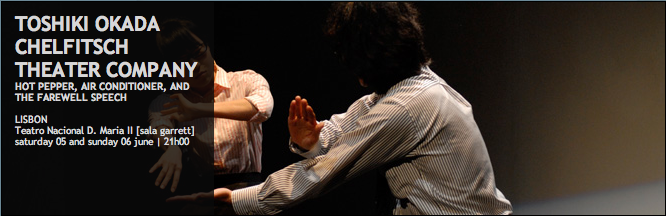
TOSHIKI OKADA CHELFITSCH THEATER COMPANY
HOT PEPPER, AIR CONDITIONER, AND THE FAREWELL SPEECH

Picture 5

“Hot Pepper, Air Conditioner, and The Farewell Speech,” is, in the words of its author Toshiki Okada, ‘a contemporary drama about temporary workers.’ It is a triptych, set in an office, where everything revolves around Erika, a female temp staffer soon to be laid off as a result of the current recession.

In “Hot Pepper,” employees consult a widely cir- culated coupon magazine called “Hot Pepper” seeking a suitable restaurant for their colleague Erica’s farewell party. She has just been informed that her contract will soon be terminated.

“Air Conditioner” enacts a conversation between two contracted workers – a man and a woman who do not share the anxiety that Erika’s firing has caused among the temp staffers. During the entire scene, the woman complains that the air conditioning in their office is set too low, while the man expresses his sympathy for his coworker. Finally, “The Farewell Speech” dramatizes Erika’s last words, spoken 5 minutes before the end of the very last day of her contract. The speech is given in front of all the staff as they gather to bid her farewell.

Toshiki Okada gained fame in Japan with his the- ater productions that combine a hyper-colloquial Japanese with a very specific way of moving around on stage. In “Air Conditioner,” for instance, movement represents an almost absurd tension or gap between two different kinds of physicality: gestures as acting, on the one hand, and physical movements that respond to background music, on the other. Okada founded the Chelfitsch Theatre Company (after a deliberate mispronunciation of the English word ‘selfish’) in the late nineties. He writes and directs all of its productions.

VIDEO:

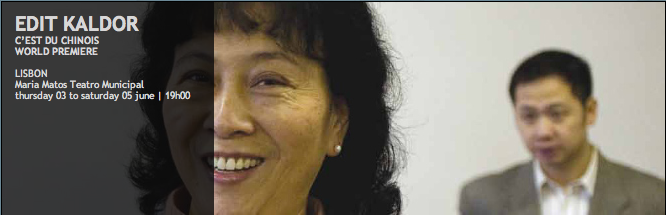
EDIT KALDOR
C’EST DU CHINOIS
WORLD PREMIERE

Picture 6

On stage: five Chinese citizens, determined to open their hearts to the public. The only language they speak is Mandarin, but they are convinced this should not stand in the way of a fruitful exchange with the audience.

Using the wide range of possibilities of theatrical expression, they teach us basic oral comprehension of the Mandarin language, just enough to understand the gradually unfolding narrative: a story fuelled by dormant troubles and unresolved dilemmas involving the intertwined personal histories of the performers.

An extended family of five people, whose lives have been inextricably linked, confronts the question, ‘Where did it all go wrong for us?’ The performers call upon the audience to bear witness as they untangle the knots of an uncomfortable truth. It is vital for each performer to tell his or her version of this truth, to clarify his or her role in the events. They all want to figure out for themselves what exactly happened and where to go from here.

In essence, “C’est du chinois” is about communication – a communication that is basically impossible, but which nevertheless comes into being through the common effort of players and spectators. Starting at zero, they create something together – the possibility of a personal encounter, of an intimate, face-to-face meeting.

Edit Kaldor was born in Budapest. She immigrated as a child to the United States, where she then lived for ten years. She studied literature and theatre at Columbia University and worked as a dramaturge and video-maker with Peter Halasz (Squat theater/Love theater, New York). After enrolling at DasArts (the postgraduate performing arts center in Amsterdam), she started writing and directing her own theatre work and quickly received international acclaim. In recent years her daring, existential theatre performances, which often integrate the use of documentary elements, have toured widely in Europe and beyond.

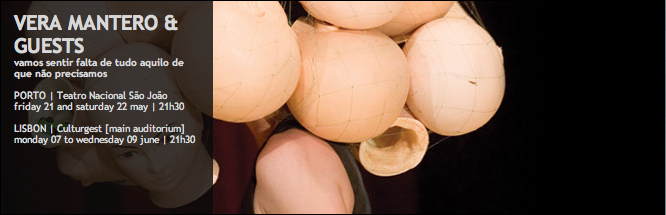
VERA MANTERO & GUESTS
vamos sentir falta de tudo aquilo de que não precisamos

Picture 4

Etymologically, the word ‘object’ denotes the idea that an object is something that is placed before us, something that exists or that is meant to be seen. “vamos sentir falta de tudo aquilo de que não precisamos” (“we are going to miss everything we don’t need”) presents objects of the world. A rebound effect and an unexpected unveiling of meaning(s) develop between these objects and those who manipulate them. And thus a triangle emerges between the objects, those who manipulate them, and the spectator – a tension that pushes the boundaries of ideas and sensations towards the vibrating force of symbols.

Faced with these objects, ideas become paths to other ideas, and as on all paths, there are passages that widen, narrow and bifurcate. We can follow these trails with different rhythms and breathing patterns, as if thoughts were shaped by the way they pulsate and clash.

In contact and short-circuiting, these objects of the everyday world are somewhere between the material and the ethereal, the quotidian and the dreamlike, the generic and the exceptional. And it might be precisely in this rearrangement of our everyday world – this world of generic objects, production, consumption and waste – that we can touch another side of things.

(Rita Natálio)

Together with Christophe Ives, Marcela Levi, Miguel Pereira, Rita Natálio, Nadia Lauro e Andrea Parkins, Vera Mantero distilled this very unusual parade out of months of reading, watching and listening, reflecting and conversing. “vamos sentir falta de tudo aquilo de que não precisamos” is a game of associations, sometimes explicit, sometimes cryp- tic, playful or uncomfortable, tangible or volatile. It triggers many questions, answers hardly any. One year after its premiere in Essen and Montpel- lier in 2009, Vera Mantero and guests will finally present this work in Portugal.

Highlights: The Festival d’Avignon July 7-21, 2010 (France)

ABOUT:

“We have conceived this 64th Festival together with director Christoph Marthaler and writer Olivier Cadiot, our two associate artists. In the course of our many conversations, we have encountered two creative minds fully immersed in today’s reality, two “anthropologist artists” of our daily lives. Their literary and theatrical writings, imbued with musicality, closely scrutinise the man of today. They live in the present and it’s the present they give us to see, mixing high brow and popular culture with unexpected traces of the past unearthed from their imaginary archaeological digs.

Both have entered the world of theatre through a dialogue with other artists. The stage designer Anna Viebrock creates spaces for Christoph Marthaler to inhabit with his troupe of actors and singers. Olivier Cadiot’s writings are brought to life on stage by director Ludovic Lagarde and his actors, including Laurent Poitrenaux.

Built in the 14th century as a symbol of religious and political power, the Popes palace, its architecture and its History will be the starting point for Papperlapapp, Christoph Marthaler’s new musical and theatrical piece. It will also be the setting for the tragic fate of Richard II who, at the end of this same 14th century, surrendered to his human fragility when confronted to the demands of exercising power. This Shakespeare tragedy was the first ever presented at the Festival d’Avignon in 1947; this year it will be given in a new translation, starring Denis Podalydès in the title role. Olivier Cadiot’s novel, A Nest What For, which will be adapted for the stage, also questions the figure of the king, experiencing this time a very contemporary exile.

We have travelled, from Basel to Vienna, through Mitteleuropa whose literature, upset by the madness of war at the turn of the 20th century, will also be present on our stages with The Man without qualities by Musil, Kafka’s The Trial, Brecht’s Baal and, as a more recent reminder, Ionesco’s Frenzy for Two or More.

With the presence of Angélica Liddell, Julie Andrée T., Jean Lambert-wild, Christophe Huysman, Faustin Linyekula, Massimo Furlan and Falk Richter, we will prominently feature contemporary authors writing for the stage today. Words, bodies, sometimes music, shape the languages these artists use, exploring forms of expression between theatre and performance. They recount our times through their pain, their anger or their tenderness.

Our behaviours, our stories, luminous or dark, will be examined in the shows of Philippe Quesne, Gisèle Vienne, Stanislas Nordey, Zimmermann & de Perrot and the GdRA, all of them questioning on stage the fragility of our human condition. As will, in a more abstract way, the choreographed performances of Alain Platel, Cindy Van Acker, Anouk van Dijk, Josef Nadj, Boris Charmatz, Pierre Rigal, and Anne Teresa De Keersmaeker, the latter drawing inspiration from the ars subtilior music, invented in Avignon at the court of the Popes.
Music will be present throughout the Festival, notably with concerts by Pascal Dusapin and Rodolphe Burger, who will moreover orchestrate a large-scale ball for the 14th of July by the Pont d’Avignon. Contemporary literature will also be heard on many stages as well as in a series of readings.

The Festival will be cadenced by ten rendez-vous of The 25th Hour, offbeat lecture-shows and surprising projects brought about by actors otherwise present at the Festival, and by the eight pieces created for the Sujets à Vif, all of them from commissions based on an artistic encounter.

To share or deepen your experience as an audience, we invite you to the École d’Art for daily encounters with the artists and to the Gymnase Saint-Joseph to hear philosophers debate at the The Theatre of Ideas.

These collective experiences give us tools to better comprehend our present times of social and economic crisis. This “being together” uniting artists and audiences, essential for the theatre to happen, helps us resist closing ourselves to the world and yielding to the temptation of letting the very notion of public value dissolve before our eyes.

Many of these shows are being created and rehearsed specially for the Festival d’Avignon, many artists will come to the Festival d’Avignon for the first time. We trust you will be curious again this summer and we invite you to immerse yourself in this new Festival.”

Hortense Archambault and Vincent Baudriller
Directors
Avignon, 3rd May 2010

HIGHLIGHTS:

Gisèle Vienne (Premiere)
This is how you will disappear
July 8-10 & 12-15

Everything starts in a forest. Extremely natural, inhabited by a buzzard in feathers and bones, this wooded landscape is staged like the reflection of the interior experiences of the characters who cross it. Depending on the light, mist and sound atmosphere, the metamorphosis capacity of the place is astonishing, following the example of the feelings driving the spectators, which go from harmony to danger, from the experience of beauty to anxiety in front of nature. It is through the spectacle of the forest that each individual dialogues with his private impressions, sometimes the most secret, like an entry into oneself, both individual and collective. But the forest is alive, full of tales, images, fantasies, forest myths as familiar as they are disturbing. Three figures soon spring up, including two archetypal beauties of today, post-adolescent idols: the young athlete, the perfection of appearances, and the rock star, the suicidal aura of ruin. Between the two of them: the trainer, the value of authority, of the taming of the body, suddenly confronted by primitive impulses and chaos. Every thing here is contained in contradiction, in the disturbing virtue of opposites and works on this tension that the show makes the spectators feel emotionally, physically and aesthe?tically. Changing visions of nature, passing in a breath, in a ray of light or a trace of smoke, from well-being to fear. Situations varying from one extreme to the other, from serenity to the most brutal murder. As an expert in perturbation, Gisèle Vienne composes images of a world in constant motion, from the imperceptible evolution to the most destructive chaos. It is over the forest that we see this, in the wood that we hear everything. Rarely has tree foliage been so revelatory as in this nature-driven theatre.

conception, mise en scène, chorégraphie et scénographie Gisèle Vienne
direction musicale Stephen O’Malley
création musicale
Stephen O’Malley, Peter Rehberg, KTL, Ensemble Pearl
interprétation et diffusion live
Stephen O’Malley, Peter Rehberg
texte Dennis Cooper
traduction Laurence Viallet
lumière Patrick Riou
vidéo Shiro Takatani
sculpture de brume Fujiko Nakaya

créé en collaboration avec et interprété par
Jonathan Capdevielle, Margrét Sara Gudjónsdóttir, Jonathan Schatz

Philippe Quesne Vivarium Studio (Premiere)
Big Bang
July 19-21 & 23-26, 2010

After seven years of shared life, the members of the Vivarium Studio have slightly changed there eco-system. Some of them have left or taken a pause, others have arrived. The desire for renewal, encounters and formal experiments has relaunched the group toward a new show. “For each crea?tion,” Philippe Quesne explains, “the writing begins during rehearsals, with the show’s title, a pretext for experimentation – from the creation process to performance – that nourishes a form of ambiguity between the true and the false, the real and the artificial.” Big Bang evokes as much a gigantic explosion as a founding theory or a simple comic book onomatopoeia. The play could take place on a small island, on which a shipwrecked group would remake the world, would go back to the origins to replay history in an accelerated fashion. A place that would serve as a frame for a succession of tableaux, like short plays, perhaps musicals, that would be used for the almost anatomical study of a human microcosm put into an unexpected geography. Big Bang will thus unfold a type of evolutionary theory, marking ruptures, inventions, decompositions, disappearances, like the strangest mutations. Undoubtedly men and animals, silence and languages, nothing and everything will exist: the floatation of the living. From plankton to post-modern, the Gymnase Aubanel will welcome the large and small history of mankind.

conception Philippe Quesne
avec Isabelle Angotti, Rodolphe Auté, Jung-Ae Kim, Émilien Tessier, César Vayssié, Gaëtan Vourc’h (distribution en cours)
production Vivarium Studio
coproduction Festival d’Avignon, La Ménagerie de Verre-Paris, Hebbel am Ufer (Berlin), Kunstencentrum Vooruit (Gand), Internationales Sommerfestival (Hambourg), Les Spectacles vivants-Centre Pompidou-Paris, Théâtre de l’Agora Scène nationale d’évry et de l’Essonne, NXTSTP (avec le soutien du Programme Culture de l’Union européenne) : Festival Baltoscandal (Rakvere), Rotterdamse Schouwburg (Rotterdam)
avec le soutien de la Région Île-de-France et du CENTQUATRE Établissement artistique de la Ville de Paris
Le Festival d’Avignon reçoit le soutien de l’Adami pour la production.